Wels catfish.
Silurus glanisLinnaeus, 1758
The largest native freshwater fish of central Europe: broad-headed, scaleless and mostly nocturnal.
LCLeast Concern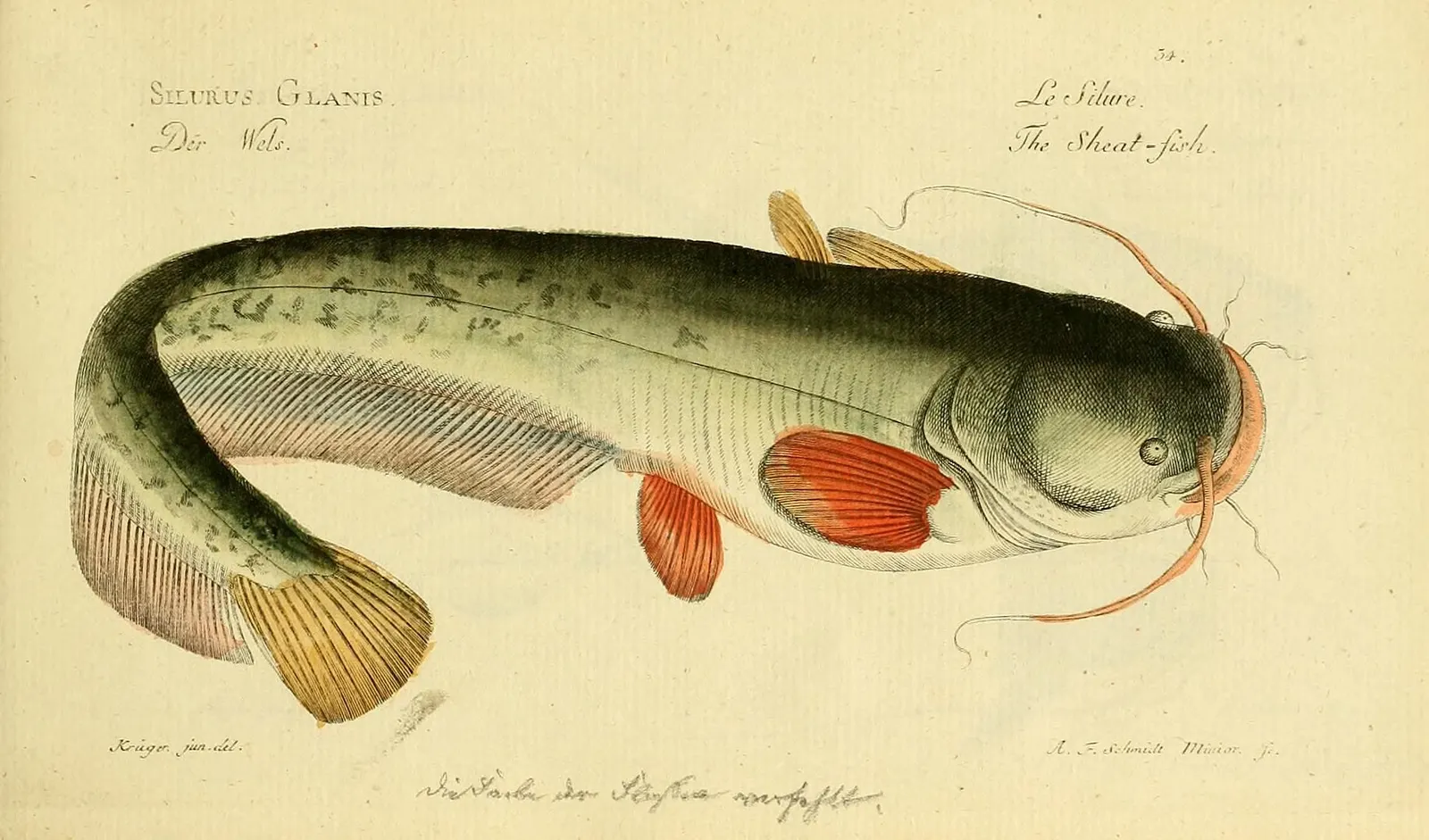
Where to find it.
Native to central and eastern Europe and western Asia as far as the Aral Sea; introduced to Spain, Italy, France and Britain, among others.
Also known as Sheatfish.
A closer look.
A smooth, slimy body without scales, round in front and flattened towards the tail. The anal fin is very long, the dorsal fin tiny. Six barbels: two long ones on the upper jaw and four short ones beneath the chin.
How it lives.
Active mainly at dusk and night, finding food by taste, touch and the lateral line. By day it rests in deep holes, under roots or undercut banks.
The next generation.
Spawns in early summer at water temperatures of about 20 °C. The male builds a nest and guards the eggs until the larvae hatch.
Conservation
Not threatened. Where it has been introduced, its effect on native species, including migrating salmon and shad, is under study.
Least Concern — global IUCN assessment dated 29 May 2022. Regional populations can have a different status. View the Red List record ↗
In the margins.
- In the river Tarn in southern France, researchers filmed wels lunging onto the bank to catch pigeons, sometimes stranding themselves for a moment.
- Most length records above 2.8 m come from the river Po in Italy.
FishBase — Silurus glanis ↗
IUCN Red List — assessment ↗
M. E. Bloch, Ichthyologie, ou Histoire naturelle des poissons, pl. 34. Public domain ↗. Reproduced as resized WebP files.
Keep looking.
Next: Brown trout ↗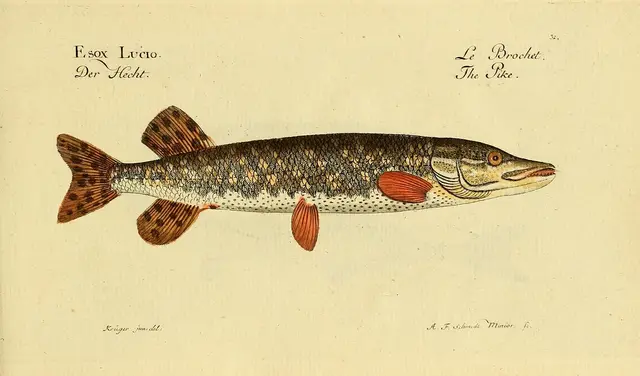
Northern pike
LCEsox lucius
An ambush predator of weedy lakes and slow rivers, built almost entirely for one thing: the sudden lunge.
Freshwater / Brackish
European perch
LCPerca fluviatilis
Probably the first fish many European children ever catch, recognisable by its dark bars and spiny back.
Freshwater / Brackish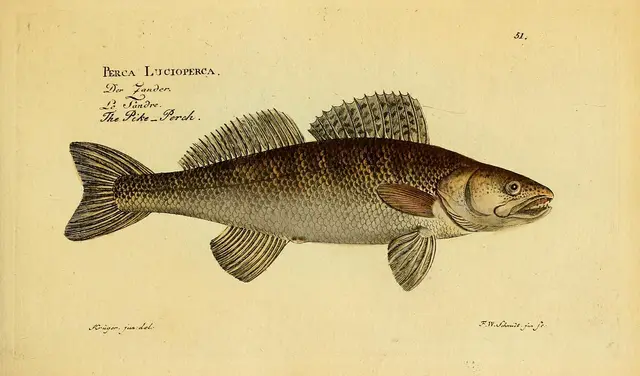
Zander
LCSander lucioperca
A pale, glassy-eyed predator that does its best work in murky water and at dusk.
Freshwater / Brackish