Northern pike.
Esox luciusLinnaeus, 1758
An ambush predator of weedy lakes and slow rivers, built almost entirely for one thing: the sudden lunge.
LCLeast Concern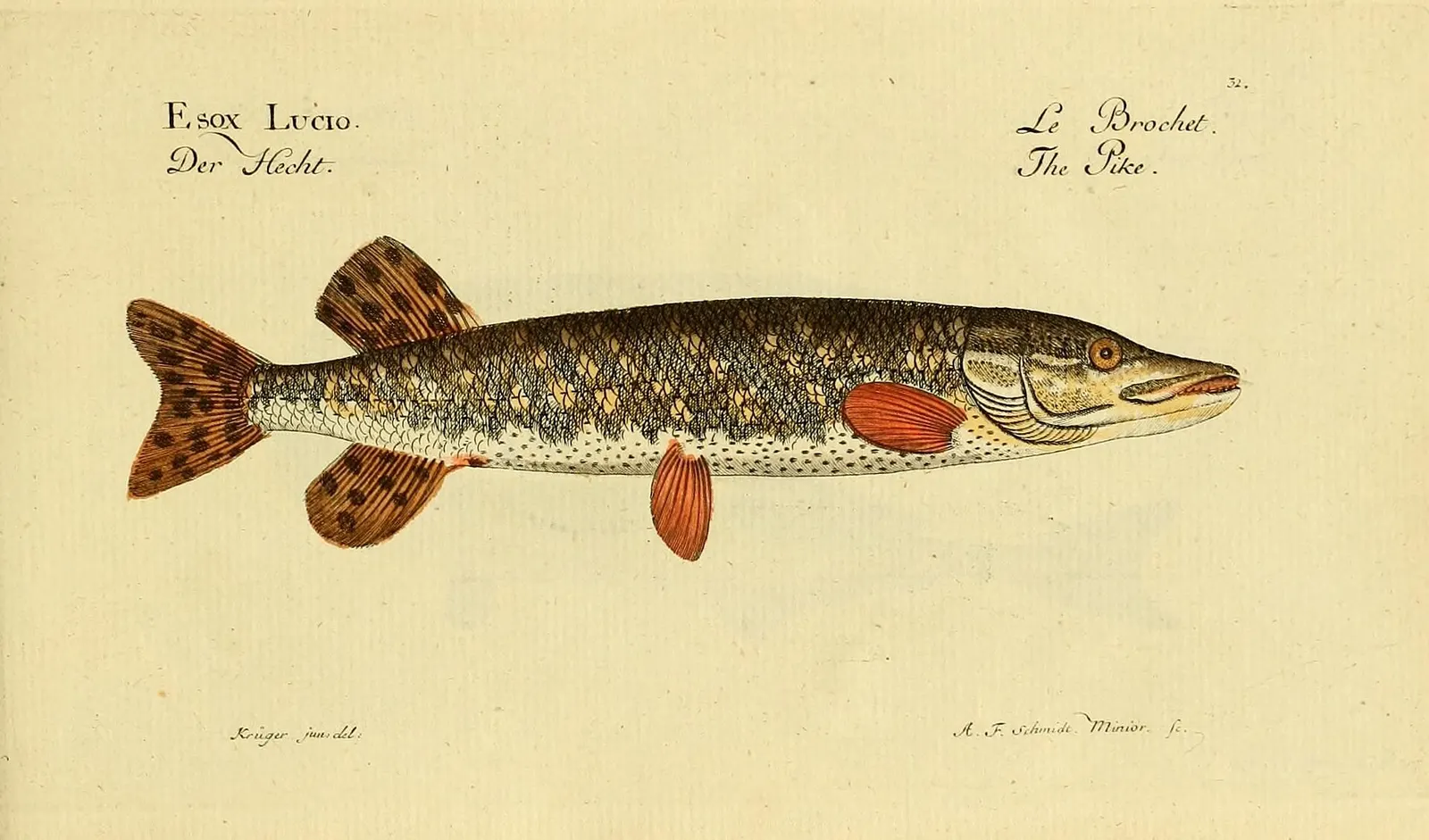
Where to find it.
Circumpolar across the northern hemisphere: Europe, northern Asia and North America. Also in the brackish bays of the Baltic.
Also known as Pike, Jack.
A closer look.
Long, torpedo-shaped body with the dorsal and anal fins set far back near the tail, which gives the fish its explosive acceleration. The flat, duck-bill snout holds large fangs in the lower jaw and rows of backward-pointing teeth on the roof of the mouth. Green-brown flanks with pale spots make it nearly invisible among water plants.
How it lives.
Pike are solitary and hunt mostly by sight. They hang motionless in the weeds and strike at passing prey from a standstill, relying on eyesight and the lateral line. Cannibalism is common, especially among young fish.
The next generation.
Spawning takes place in early spring, often just after the ice melts, in shallow vegetated margins and flooded meadows. Females grow considerably larger than males.
Conservation
Not threatened globally. Local populations suffer where floodplains and reed beds that serve as spawning grounds are drained or built over.
Least Concern — global IUCN assessment dated 15 July 2022. Regional populations can have a different status. View the Red List record ↗
In the margins.
- One of very few freshwater fish native to both Europe and North America.
- In the Baltic it lives in brackish water, sharing the coast with marine species.
FishBase — Esox lucius ↗
IUCN Red List — assessment ↗
M. E. Bloch, Ichthyologie, ou Histoire naturelle des poissons, pl. 32. Public domain ↗. Reproduced as resized WebP files.
Keep looking.
Next: European perch ↗
European perch
LCPerca fluviatilis
Probably the first fish many European children ever catch, recognisable by its dark bars and spiny back.
Freshwater / Brackish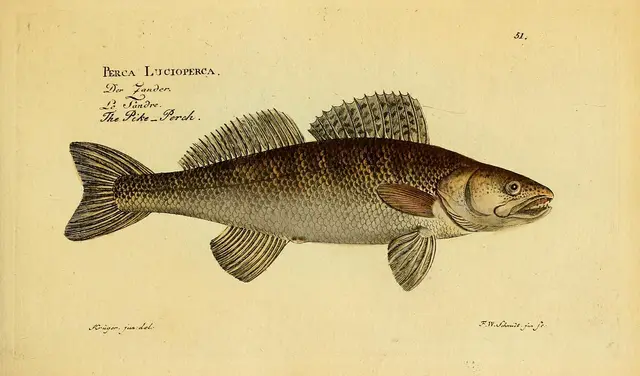
Zander
LCSander lucioperca
A pale, glassy-eyed predator that does its best work in murky water and at dusk.
Freshwater / Brackish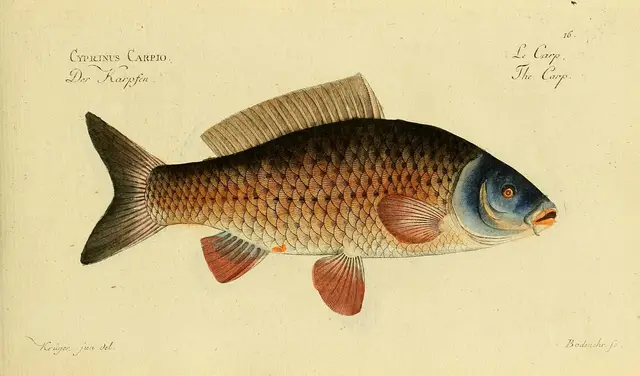
Common carp
LCCyprinus carpio
One of the oldest farmed fish in the world. Wild river populations live alongside domesticated forms introduced around the globe.
Freshwater / Brackish