West Indian Ocean coelacanth.
Latimeria chalumnaeSmith, 1939
Known only from fossils and assumed extinct since the Cretaceous, until a live one was landed in South Africa in 1938.
CRCritically Endangered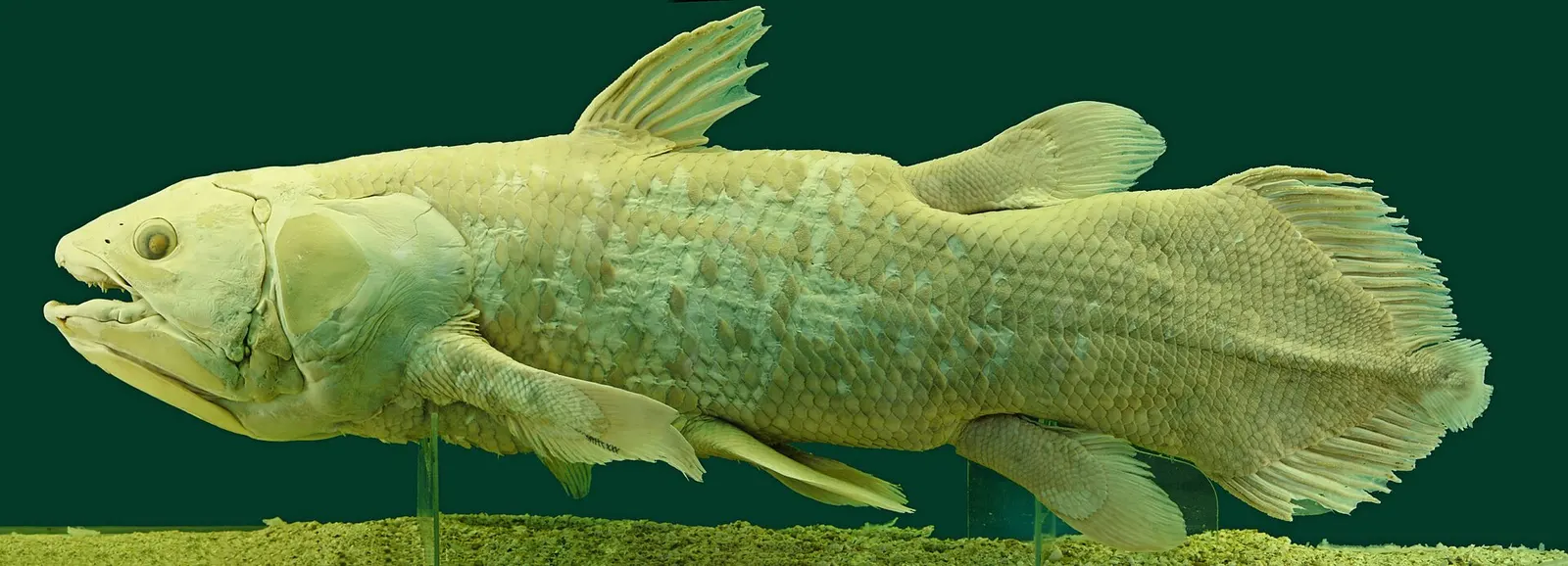
Where to find it.
The western Indian Ocean, mainly around the Comoros, with records off South Africa, Mozambique, Madagascar, Kenya and Tanzania.
Also known as Coelacanth, Gombessa.
A closer look.
Steel blue with irregular white blotches that identify each individual. The pectoral, pelvic, anal and second dorsal fins sit on fleshy, limb-like lobes, and the tail has a small extra lobe in the middle.
How it lives.
By day coelacanths rest in groups in caves on steep volcanic slopes at about 150–250 m. At night they drift out to feed. They move their paired fins in alternation, much as four-legged animals move their legs.
The next generation.
Gives birth to live young. A 2021 study estimated a pregnancy of about five years and sexual maturity at around 55 years of age.
Conservation
Critically Endangered. The total population is very small; the main threat is bycatch in deep-water fishing.
Critically Endangered — global IUCN assessment dated 30 June 2000. Regional populations can have a different status. View the Red List record ↗
In the margins.
- The museum curator Marjorie Courtenay-Latimer recognised the catch in 1938; the ichthyologist J. L. B. Smith described it and named the genus after her.
- A second species, Latimeria menadoensis, was found in Indonesia in 1997–98.
- There is no 18th-century plate here because there could not be one: this is a photograph of a museum specimen.
FishBase — Latimeria chalumnae ↗
IUCN Red List — assessment ↗
Photo: Alberto Fernandez Fernandez, via Wikimedia Commons. Author: Alberto Fernandez Fernandez. CC BY-SA 3.0 ↗. Reproduced as resized WebP files. Licensed under Creative Commons Attribution-ShareAlike 3.0; the adapted image is shared under the same licence.
Keep looking.
Next: Northern pike ↗
Brown trout
LCSalmo trutta
One species, several lives: the stream-dwelling brown trout, the lake trout and the sea-going sea trout.
Freshwater / Brackish / Marine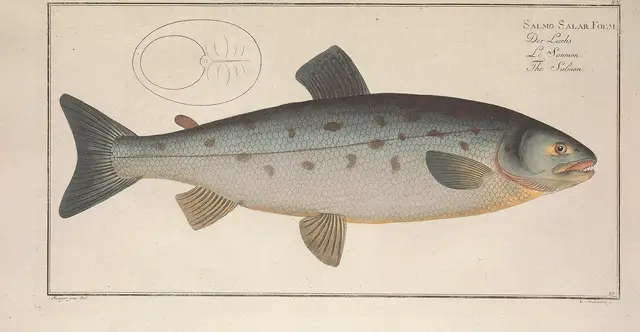
Atlantic salmon
NTSalmo salar
The archetypal migrant: it grows up at sea and returns to its home river to spawn.
Freshwater / Brackish / Marine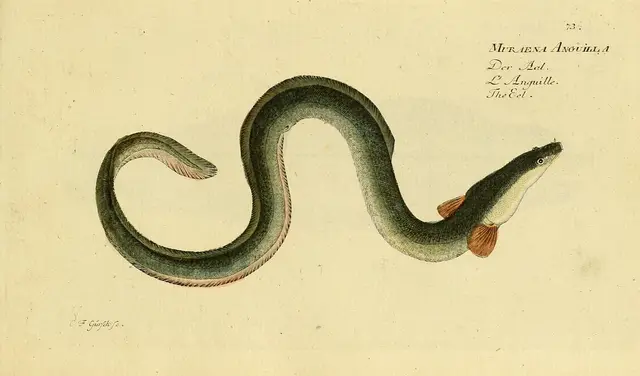
European eel
CRAnguilla anguilla
Its life cycle is one of the great unsolved puzzles of natural history, and the species is now critically endangered.
Freshwater / Brackish / Marine