European eel.
Anguilla anguilla(Linnaeus, 1758)
Its life cycle is one of the great unsolved puzzles of natural history, and the species is now critically endangered.
CRCritically Endangered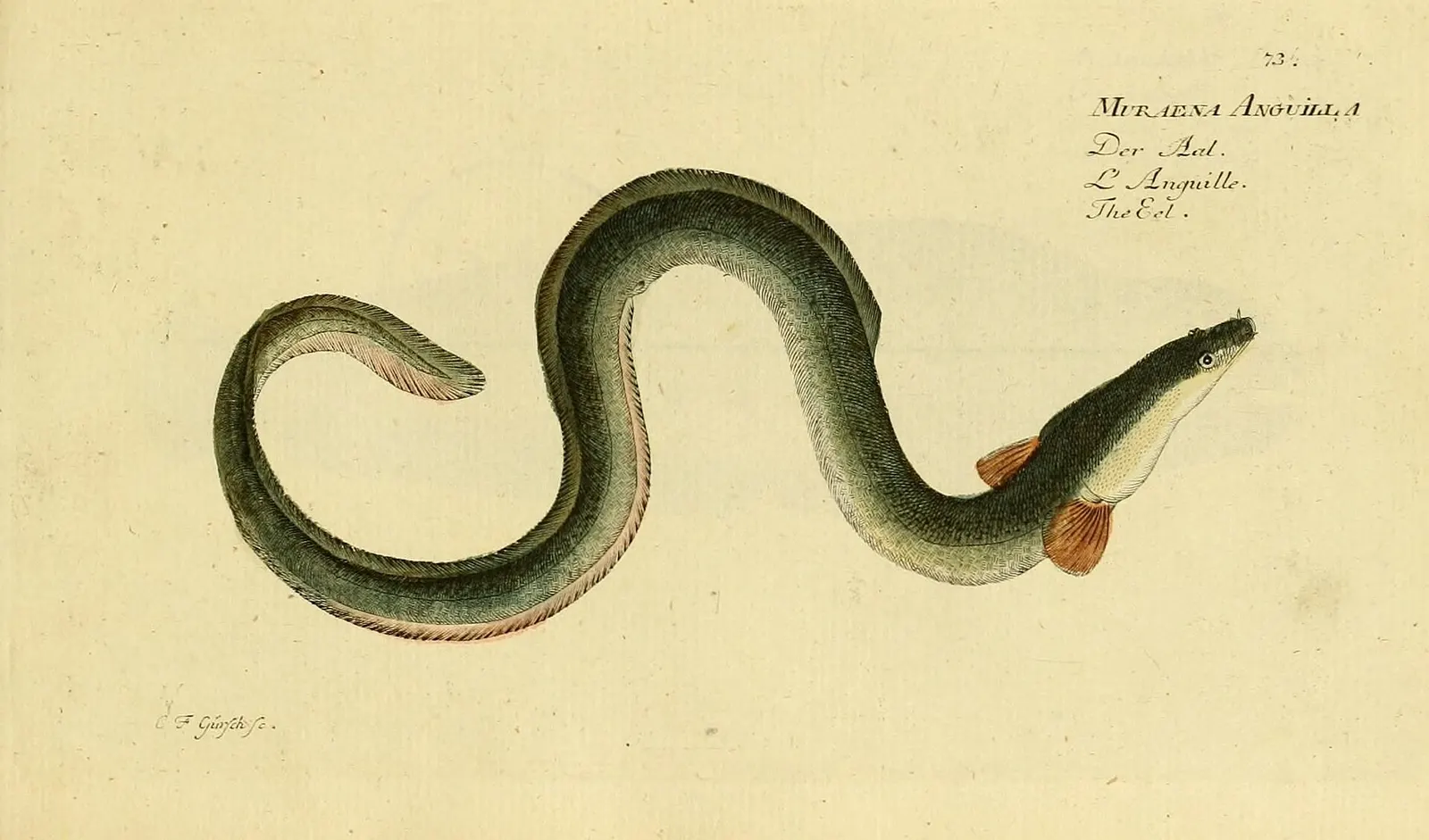
Where to find it.
Coasts and inland waters of Europe and North Africa. The spawning area is believed to lie in the Sargasso Sea in the western Atlantic.
Also known as Eel.
A closer look.
A snake-like body with one continuous fin running from the back around the tail to the belly. There are no pelvic fins. The tiny scales are buried deep in the slimy skin.
How it lives.
The leaf-shaped, transparent larvae (leptocephali) drift with ocean currents to Europe and turn into see-through glass eels at the coast. As yellow eels they may spend many years in rivers and lakes. Once mature, they become silver eels and travel thousands of kilometres back into the Atlantic.
The next generation.
Spawning has never been observed in the wild. The smallest larvae have been found in the Sargasso Sea, which is why the spawning ground is placed there. The adults are thought to die after spawning.
Conservation
Listed as Critically Endangered since 2008. The number of glass eels reaching Europe has collapsed since the 1980s. Threats include migration barriers, hydropower turbines, overfishing, habitat loss, an introduced swim-bladder parasite (Anguillicola crassus) and illegal trade in glass eels.
Critically Endangered — global IUCN assessment dated 7 November 2018. Regional populations can have a different status. View the Red List record ↗
In the margins.
- In the early 20th century the Danish researcher Johannes Schmidt narrowed down the spawning area by charting where the smallest larvae were caught.
- Since 2009 the species has been listed in Appendix II of CITES.
- Eels can cross short stretches of damp ground.
FishBase — Anguilla anguilla ↗
IUCN Red List — assessment ↗
M. E. Bloch, Ichthyologie, ou Histoire naturelle des poissons, pl. 73. Public domain ↗. Reproduced as resized WebP files.
Keep looking.
Next: European sea sturgeon ↗
Brown trout
LCSalmo trutta
One species, several lives: the stream-dwelling brown trout, the lake trout and the sea-going sea trout.
Freshwater / Brackish / Marine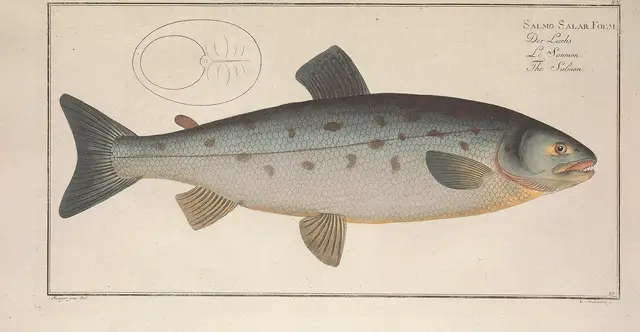
Atlantic salmon
NTSalmo salar
The archetypal migrant: it grows up at sea and returns to its home river to spawn.
Freshwater / Brackish / Marine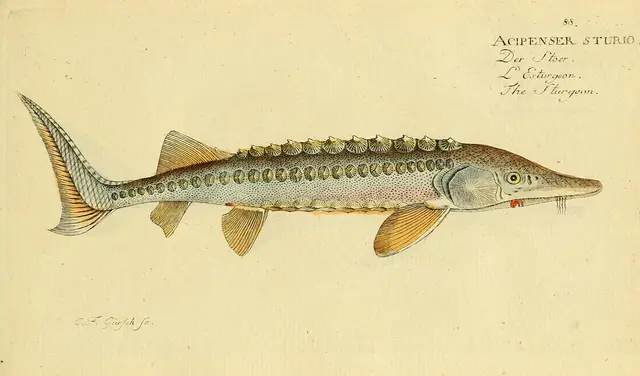
European sea sturgeon
CRAcipenser sturio
Once common enough to be an everyday food on the Elbe and the Rhine, now one of the rarest fish in Europe.
Freshwater / Brackish / Marine