Atlantic bluefin tuna.
Thunnus thynnus(Linnaeus, 1758)
One of the largest bony fish alive, and a warm-muscled long-distance swimmer that crosses the Atlantic.
LCLeast Concern
Where to find it.
The Atlantic and the Mediterranean; main spawning grounds in the Mediterranean and the Gulf of Mexico.
Also known as Bluefin, Tunny.
A closer look.
Spindle-shaped body, round in cross-section, with a crescent tail and a row of small finlets behind the dorsal and anal fins. Dark blue back, silver flanks.
How it lives.
A counter-current heat exchanger in its blood vessels (the rete mirabile) lets the bluefin keep its muscles well above water temperature, so it can hunt in cold seas.
The next generation.
Spawns in late spring and summer in warm water. Large females release millions of free-floating eggs.
Conservation
After a steep decline from overfishing, strict quotas set by ICCAT allowed the stock to recover. In 2021 the IUCN moved the species from Endangered to Least Concern.
Least Concern — global IUCN assessment dated 15 January 2021. Regional populations can have a different status. View the Red List record ↗
In the margins.
- The rod-and-reel record, about 679 kg, was caught off Nova Scotia in 1979.
- In 2019 a 278 kg bluefin sold at auction in Tokyo for 333.6 million yen.
FishBase — Thunnus thynnus ↗
IUCN Red List — assessment ↗
M. E. Bloch, Ichthyologie, ou Histoire naturelle des poissons, pl. 55. Public domain ↗. Reproduced as resized WebP files.
Keep looking.
Next: Ocean sunfish ↗
Brown trout
LCSalmo trutta
One species, several lives: the stream-dwelling brown trout, the lake trout and the sea-going sea trout.
Freshwater / Brackish / Marine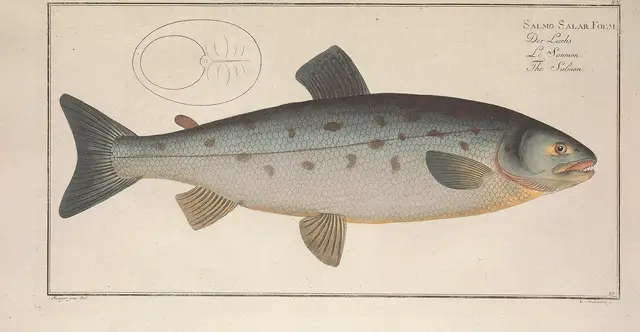
Atlantic salmon
NTSalmo salar
The archetypal migrant: it grows up at sea and returns to its home river to spawn.
Freshwater / Brackish / Marine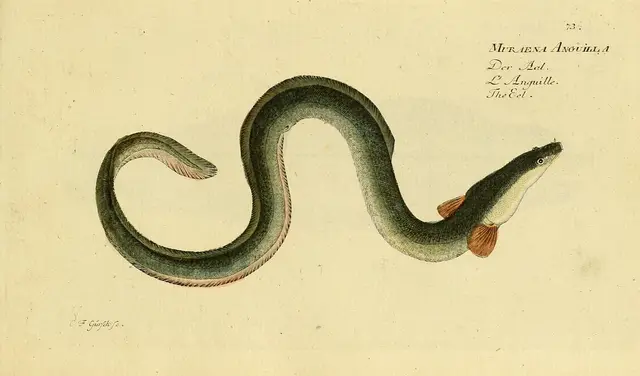
European eel
CRAnguilla anguilla
Its life cycle is one of the great unsolved puzzles of natural history, and the species is now critically endangered.
Freshwater / Brackish / Marine