Atlantic cod.
Gadus morhuaLinnaeus, 1758
For centuries cod fed whole coastlines, and then the coastlines nearly fished it out.
VUVulnerable
Where to find it.
The North Atlantic from North America via Greenland and Iceland to northern Europe, including the North Sea and the Baltic.
Also known as Cod, Codling.
A closer look.
Three dorsal fins, two anal fins and a single barbel on the chin. Mottled brown-green body with a pale, clearly visible lateral line.
How it lives.
Cod mostly stay close to the bottom on the continental shelf. Many stocks make seasonal migrations between feeding and spawning grounds.
The next generation.
A large female can release several million eggs in a season. The eggs float freely in open water.
Conservation
Listed by the IUCN as Vulnerable, though that assessment dates from 1996. Several stocks have been severely depleted by overfishing.
Vulnerable — global IUCN assessment dated 1 August 1996. Regional populations can have a different status. View the Red List record ↗
In the margins.
- After the collapse of the stocks off Newfoundland, Canada imposed a fishing moratorium in 1992, costing tens of thousands of jobs.
- Stockfish is cod dried in the open air; klippfisk is salted and dried.
FishBase — Gadus morhua ↗
IUCN Red List — assessment ↗
M. E. Bloch, Ichthyologie, ou Histoire naturelle des poissons, pl. 64. Public domain ↗. Reproduced as resized WebP files.
Keep looking.
Next: European plaice ↗
Brown trout
LCSalmo trutta
One species, several lives: the stream-dwelling brown trout, the lake trout and the sea-going sea trout.
Freshwater / Brackish / Marine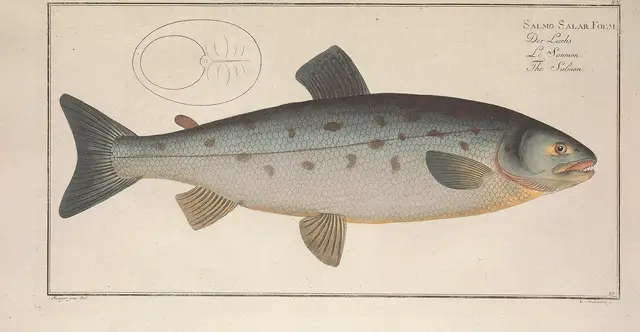
Atlantic salmon
NTSalmo salar
The archetypal migrant: it grows up at sea and returns to its home river to spawn.
Freshwater / Brackish / Marine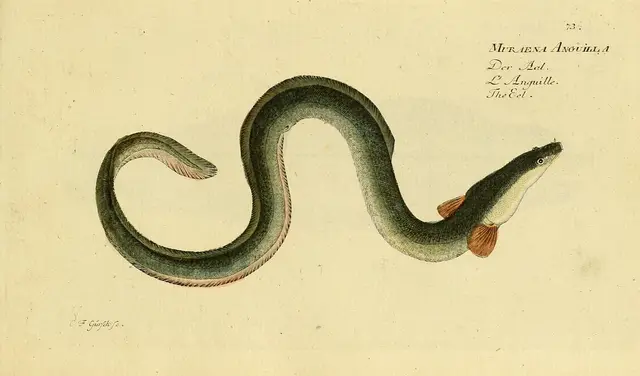
European eel
CRAnguilla anguilla
Its life cycle is one of the great unsolved puzzles of natural history, and the species is now critically endangered.
Freshwater / Brackish / Marine